How to Select the Right Fastener Grade for High-Load Industrial Applications
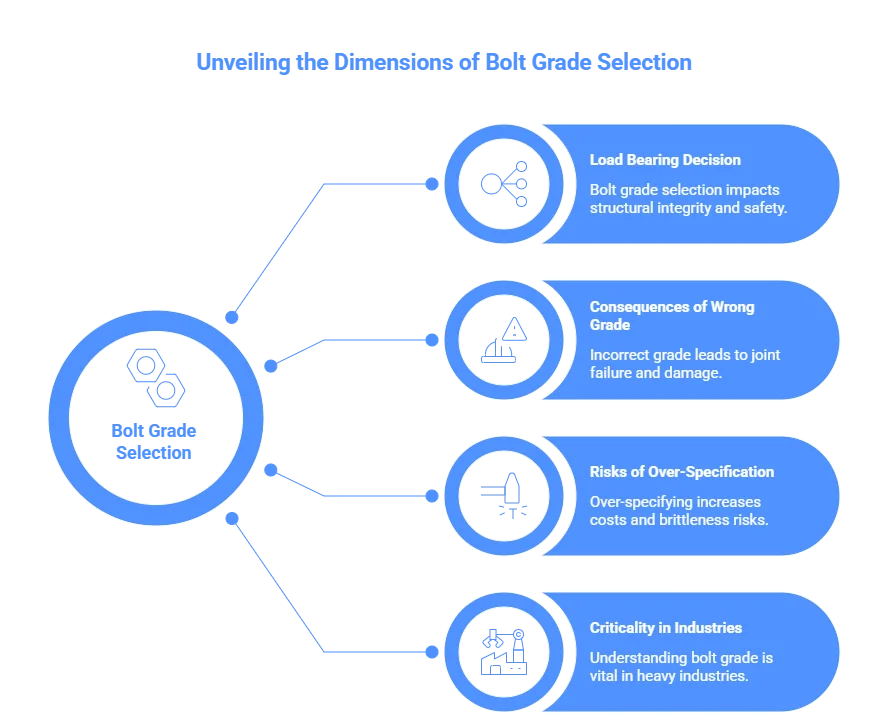
In heavy engineering, the bolt is not just a component it is a load bearing decision.
Selecting the wrong fastener grade can lead to joint failure, loss of preload, fatigue cracks, or catastrophic structural damage. On the other hand, over-specifying a grade can increase costs and even introduce brittleness risks.
Whether you’re working in mining, cement plants, oil & gas, power generation, wind energy, or heavy fabrication, understanding bolt grade selection is critical.
This guide breaks down how to choose the right industrial fastener grade for high-load applications.
Understanding Bolt Grades: What Do 8.8, 10.9, and 12.9 Mean?
In ISO metric fasteners, grades such as 8.8, 10.9, and 12.9 represent the mechanical properties of the bolt.
The first number indicates the ultimate tensile strength (UTS) in hundreds of MPa. The second number indicates the yield strength ratio (percentage of tensile strength).
Grade 8.8
Tensile strength: 800 MPa
Yield strength: 640 MPa
Suitable for general industrial assemblies
Used in moderate load, static applications
Typical uses: structural steel, brackets, general machinery.
Grade 10.9
Tensile strength: 1,000 MPa
Yield strength: 900 MPa
Higher fatigue resistance
Suitable for dynamic loads and heavy machinery
Typical uses: gearboxes, conveyors, automotive assemblies, heavy equipment.
Grade 12.9
Tensile strength: 1,200 MPa
Yield strength: 1,080 MPa
Designed for extreme load conditions
Used where compact joints require maximum strength
Engineering best practice includes safety margin based on:
Static vs dynamic load
Risk level
Consequence of failure
For high-load industrial applications, Grade 10.9 or 12.9 is often preferred due to higher preload capacity and fatigue strength.
Temperature Considerations in Bolt Grade Selection
High temperature reduces strength :
At elevated temperatures, yield strength decreases.
Alloy composition matters.
ASTM grades like A193 B7 are often specified for high-temperature pressure systems.
In oil & gas or power plants, always verify:
Maximum service temperature
Heat treatment compatibility
Risk of creep at sustained high temperature
Vibration & Fatigue: The Silent Failure Drivers
In cement plants, crushers, turbines, and mining equipment, bolts face constant vibration.
Under cyclic loading:
Lower-grade bolts fatigue faster.
Improper preload increases loosening.
Thread root becomes failure initiation point.
Common Bolt Grade Selection Mistakes
❌ Choosing Based on Availability
Using whatever is in stock instead of what engineering demands.
❌ Over-Specifying Grade
Higher grade is not always better. Excessively hard bolts may become brittle.
❌ Ignoring Environment
Corrosion + high strength = hydrogen embrittlement risk if plating is uncontrolled.
❌ Skipping Torque-Tension Validation
Torque does not automatically equal clamp force. Validation testing reduces preload scatter.
❌ Mixing Standards
Combining ISO and ASTM components incorrectly can cause mismatch in mechanical properties.
When to Choose Each Grade
Application Type
Recommended Grade
General structural steel
8.8
Heavy machinery & conveyors
10.9
Mining, wind, high dynamic loads
12.9
High temperature pressure systems
ASTM A193 B7
Corrosive marine environments
SS 316 / B8
Why Grade Selection Impacts Long-Term Cost
Incorrect bolt grade leads to:
Downtime
Maintenance rework
Safety risks
Production loss
Correct bolt grade ensures:
Structural integrity
Stable preload
Longer fatigue life
Reduced lifecycle cost
In heavy engineering, bolt grade selection is not a cost decision — it’s a risk management strategy.
The Kant Fasteners Approach
At Kant Fasteners, we support OEMs, EPC contractors, and procurement teams with:
Grade selection guidance
Heat-treated high tensile bolts (8.8, 10.9, 12.9)
ASTM-grade studs and structural fasteners
Controlled heat treatment
In-house mechanical testing
Batch traceability and documentation
Because in high-load industrial applications, precision matters — and grade selection defines performance.
Final Takeaway
When selecting industrial fastener grades:
✔ Understand load type ✔ Consider temperature ✔ Evaluate vibration & fatigue ✔ Match to ISO or ASTM standards ✔ Validate preload & mechanical properties
The right bolt grade ensures safety, uptime, and structural reliability.
Need Help Selecting the Right Fastener Grade?
Whether you need high tensile bolts for structural steel, ASTM studs for pressure systems, or custom fasteners for heavy machinery, our engineering team can guide you.